
Critical Communication. One Integrated Platform.
Capture and deliver data to the right people, in critical environments.
A single platform to ingest critical data, route it to the right person, and simplify workflows for faster, more efficient response and better-informed decision making.
An enterprise-grade messaging platform to keep complex operations connected.
The Ikonix UMS is powered by our Message Integration Engine (MIE), which acts as the central intelligence layer for your organisation.
It integrates systems, automates workflows, and delivers information to users through interfaces such as Ikonix Connect, our secure mobile app, and other communication endpoints.

Message Integration.
The advanced engine collects essential data from connected systems —nurse call, BMS, duress, sensors—and directs it through customised workflows.

Delivery destinations.
Reach every responder on their preferred device—secure smartphone app, radio pager, SMS, desktop console, or visual display.

Successfully deployed.
Proven in major hospitals and emergency services. Quick to deploy, easy to operate, and with reduced complexity, delivering faster value.
A platform delivering every message to the right recipient.
In hospitals and complex organisations, vital information is everywhere: nurse call buttons, building management systems (BMS), duress alarms, fire panels, and clinical records. The challenge is delivering that information to the right person for informed decision-making, on the right device, every time.
The Ikonix Unified Messaging Suite (IUMS) is an enterprise-grade messaging platform built around a powerful message integration engine. Connect your people, systems, and devices into a single, reliable communication hub, enabling quicker responses, less complexity, and a more connected workforce.
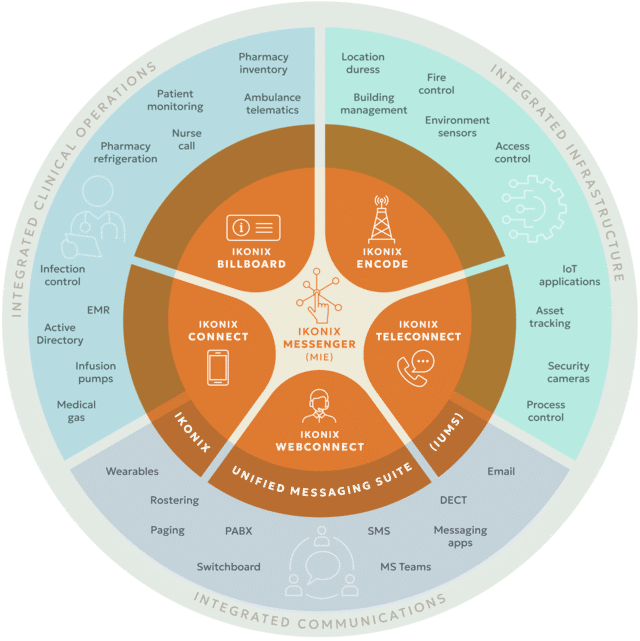
Our approach: integrate once, reach everyone, everywhere.
Instead of handling multiple point solutions, the Ikonix UMS functions as a central intelligence layer for all your communications. We focus on:
- Connecting your environment: ingesting alerts from any source — nurse call, BMS, RTLS, security, fire panels, IoT sensors, and clinical systems.
- Connecting your workforce: Ensuring alerts reach the right person or team based on their role, on-call status, and preferred device—whether it's the Ikonix Connect mobile app, a pager, a desktop console, or a facility display.
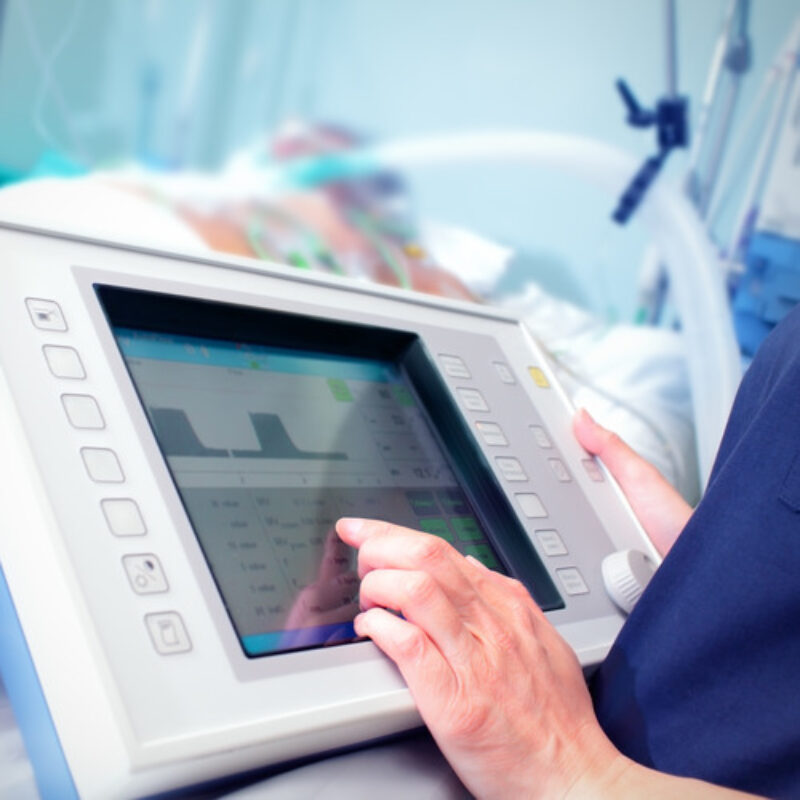
Why this matters: Designed for critical environments.
Our solutions support real hospital and emergency operations across Australia, every single day.
- Built to be resilient: We ensure messages get through in challenging situations with features like multiple communication paths, automatic re-broadcasting, and smart congestion control.
- Proven in the field: Trusted by major health and emergency service organisations, our technology supports critical communications where failure is not an option.
- Faster time to go-live: We cut project risk and cost. Connect and enhance your existing nurse call system or RTLS platform to benefit from the IUMS. We work with what you have and have a suite of existing integrations to leverage, making deployment quicker and easier than rival systems.

The heart of the system: our Message Integration Engine (MIE).
At the core of the Ikonix UMS is our powerful Message Integration Engine (MIE). Think of it as the central nervous system for your organisation's communications. Its purpose is to seamlessly ingest data from diverse sources and in a range of formats, process it intelligently according to your rules, and route it to the right person or system via the right channel, every time.
Ingest data from your existing infrastructure and anything new added later.
Process and route according to custom workflows.
Delivered to recipients’ best device, from pager to smartphone.
Ingest data from any source.
The MIE connects and communicates system information. It collects data from a broad and expanding ecosystem of over 90 different applications and systems, including:
- Clinical systems: nurse call systems, patient safety monitoring, and electronic medical records (EMR).
- Infrastructure and Environment: Building Management Systems (BMS, temperature monitors for critical refrigerators and freezers, and IoT sensors.
- Safety and Security: Fire alarm panels, security sensors, access control systems, and fixed or wireless duress alarm buttons.
- Communication Inputs: Messages initiated by staff through a desktop phone, our secure smartphone app, or an operator console.
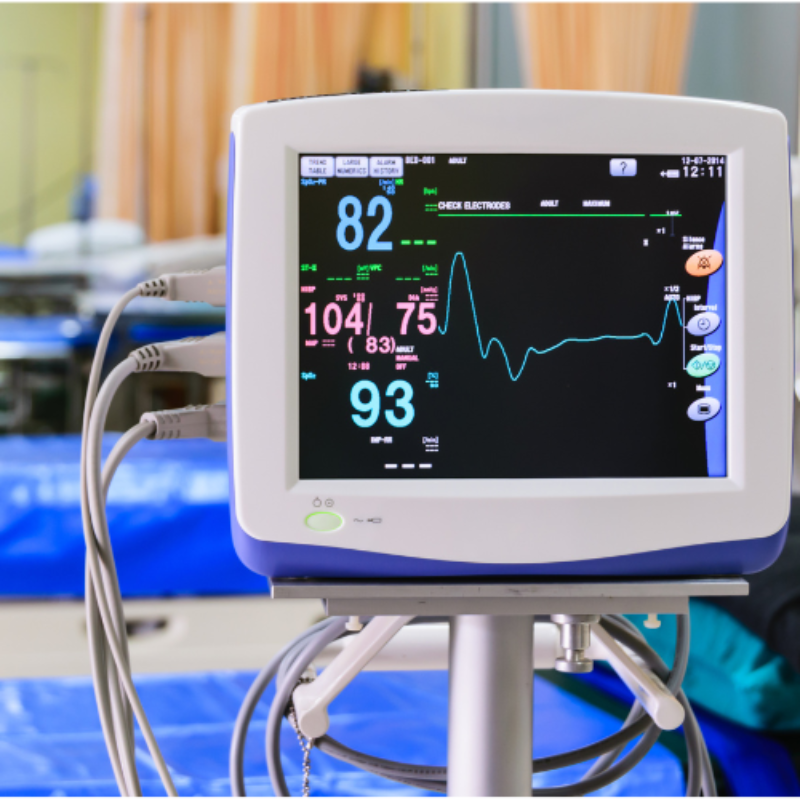
Process with intelligence.
Once data is ingested, the MIE applies your organisation's specific logic and workflows. It doesn't just pass data through; it actions your decisions:
- Enrichment: the MIE can add context to an alert, such as appending the full location details for a duress alarm, or the on-call team's contact information to better inform the responders.
- Rules-Based Routing: It determines exactly who needs to be informed and how. For example, a rule might state: "If a fire alarm is triggered in Zone A, notify the facilities manager (via SMS), the two closest security officers (via the smartphone app), and display the alarm location on the command centre screen."

Deliver to any destination.
The MIE ensures information reaches its intended recipient, regardless of their device or location. Delivery options include:
- Mobile systems: We can deliver data to our secure smartphone app, Ikonix Connect, as well as via SMS through secure gateways or mobile carriers, and even to capable DECT telephone handsets. We also manage radio paging networks now capable of utilising military-grade 128-bit encryption.
- Fixed kiosks and terminals: We can output messaging to email and MS Teams. One of the most vital parts of the network is our intelligent operator consoles for switchboard staff, which offer complete visibility and control and require only a browser to access.
- Visual display monitors and signage: Location-aware visual displays for command centres, wards, or public areas provide filtered, relevant content for that installation, or mapping of location-specific events, such as live-tracked duress alarms, or break-glass and fire panel outputs, to drive safety in the facility.

The benefits of this integrated approach.
- Breaking down silos: Ikonix UMS links different systems (such as security, facilities, and clinical) that usually don't communicate with each other, allowing a coordinated response to complex events.
- Future-proofing your investment: As your organisation adds new sensors, systems, or communication devices, the Ikonix UMS can integrate them without needing to replace your core infrastructure.
- True workflow automation: By connecting system inputs to human or digital outputs, the Ikonix UMS simplifies complex communication processes, reducing manual work and the risk of human errors.































Delivering critical information where it needs to be.
Ikonix UMS processes data received from both user inputs and system endpoints, but a key question remains: where can it send this information? Understanding the pathways and destinations for its output is essential to grasping the full scope of its functionality.

Secure smartphone messaging.
Expand critical communication to mobile devices using our purpose-built Ikonix Connect mobile app. It surpasses standard messaging by facilitating rich secure collaboration during incidents. Responders can share photos, start a secure video call with a specialist, or request quick message acknowledgment for tasking, all while maintaining a comprehensive audit trail. Find and contact the on-call cardiologist, an available security officer, or the facilities team for a given area by role, rather than searching through static lists or printed rosters. The platform integrates with your personnel directory to allow direct contact and collaboration while displaying live activity status.

Intelligent switchboard console.
Make your switchboard or command centre the hub of operational efficiency. With a browser-based interface, operators gain complete oversight of hospital-wide communications. They can access the live directory, use programmable hotkeys for instant dispatch of critical events (such as a Code Blue or an evacuation order), and manage dynamic on-call rosters with simple drag-and-drop tools. Rosters are then updated in the Ikonix Connect app and on intranet-publishable pages, so everyone can identify the right on-call assistance.

Location-aware visual displays.
Transform any screen—from a large command centre video wall to a small display in a ward corridor—into a dynamic source of real-time information. These displays are directly connected to the Ikonix UMS, providing a live feed of critical alerts. They can show the exact location of a duress alarm on a floor plan as driven by metre-accurate RTLS, or keep a fixed station informed with a customised feed of information, with both visible alerts and audible tones to attract attention when necessary.
To learn more about how live displays enhance safety and operations, read our case study for The Queen Elizabeth Hospital here.

Paging communications, modernised.
Radio paging networks remain crucial for coverage and reliability in many critical settings. Our platform updates these systems for the modern era. It acts as a software-defined integration layer between the Ikonix UMS and the antenna network, adding encryption and smart traffic management to ensure priority messages are delivered significantly faster, even during network congestion. When deployed in tandem with our smartphone solution, users can also send pages directly from their handset, reducing the burden on the switchboard.
In delivering, upgrading, or maintaining paging networks, Ikonix Technology manages state- and city-wide services in Sydney, Adelaide, Canberra, and the NT, as well as designing and deploying comprehensive coverage within major hospitals.
Frequently Asked Questions (FAQ)

The Ikonix UMS is designed to integrate, not replace. Our Message Integration Engine (MIE) connects to a wide range of systems using their standard interfaces, such as APIs, serial connections, or contact closures. We have pre-built and tested integrations for over 90 different applications from major vendors. If your specific system isn't already in our library, our team can work with you and your vendor to develop a new integration to ensure your existing investments are protected.
Absolutely. Paging networks are essential for coverage in many settings. Instead of replacing them, our platform can upgrade them. The Ikonix UMS allows you to keep your pagers while gaining benefits such as encryption to protect patient data and smart traffic management to ensure urgent codes get through faster, even during busy times. The Ikonix UMS also acts as a modern integration layer for your paging system, linking it to your other tech, so alerts from other systems can be routed to paging receivers, including from other personnel using our smartphone app.
The platform supports a wide range of devices and can send messages to almost any endpoint. This includes smartphones (via our secure app with text, voice, video, and media-sharing capabilities), standard mobile phones (via SMS), pagers, DECT phones, and desktop computers (via an operator console or intranet portal, and outputs to email, MS Teams and other messaging platforms). Recipients can also set individual preferences, allowing messages to be sent to all their devices at once or only to their preferred device.
A key design principle of our platform is to reduce complexity and project risk. Because we integrate with your existing infrastructure, deployment is typically quicker and less disruptive. There’s no need to replace systems like nurse call or RTLS to get started. Our team works closely with yours and your other vendors to deliver a smooth, phased rollout with minimal impact on daily operations.
Security is fundamental to our platform, especially for healthcare use. All data is secure in transit and encrypted at rest, with industry-standard protocols. For sensitive communications sent over paging networks, we provide optional AES encryption. The platform also keeps a complete, tamper-proof audit log of every message, including who sent it, who received it, and when, which is vital for compliance and investigations. Data stored inside Ikonix Connect, our smartphone app, is kept separate from the user’s personal data, and users can be remotely logged out to ensure a lost phone doesn’t mean accessible data.
Yes. Every message processed by the Ikonix UMS is timestamped and recorded in an unchangeable audit trail. Administrators can search and filter this history to see the full communication flow for any incident. For example, you can see exactly when a duress alert was triggered, which on-call security officer was notified, when they acknowledged it, and when the alarm was resolved, offering complete visibility and accountability.
Yes, the platform is designed to scale. It can effectively handle a single-site setup as well as large, multi-site enterprise systems or statewide health networks. The architecture supports connecting multiple Ikonix UMS instances or managing a centralised system with remote paging transmitters and localised display units, ensuring consistent communication workflows across your whole organisation.
Ready to unify your critical communications?
Capture data from any source and deliver it to any device. Proven in major hospitals. Simpler deployment, lower complexity, faster time to go-live. Get in touch.