Ikonix Billboard grows with our customers.
Ikonix Billboard continues to evolve and deliver increasing value with every new installation.
The Queen Elizabeth Hospital’s new Clinical Services Building, ‘Kangkanthi,’ was opened more than a year ago.
As another new clinical space opens on the growing TQEH campus, this is an update on how Ikonix Billboard has grown.
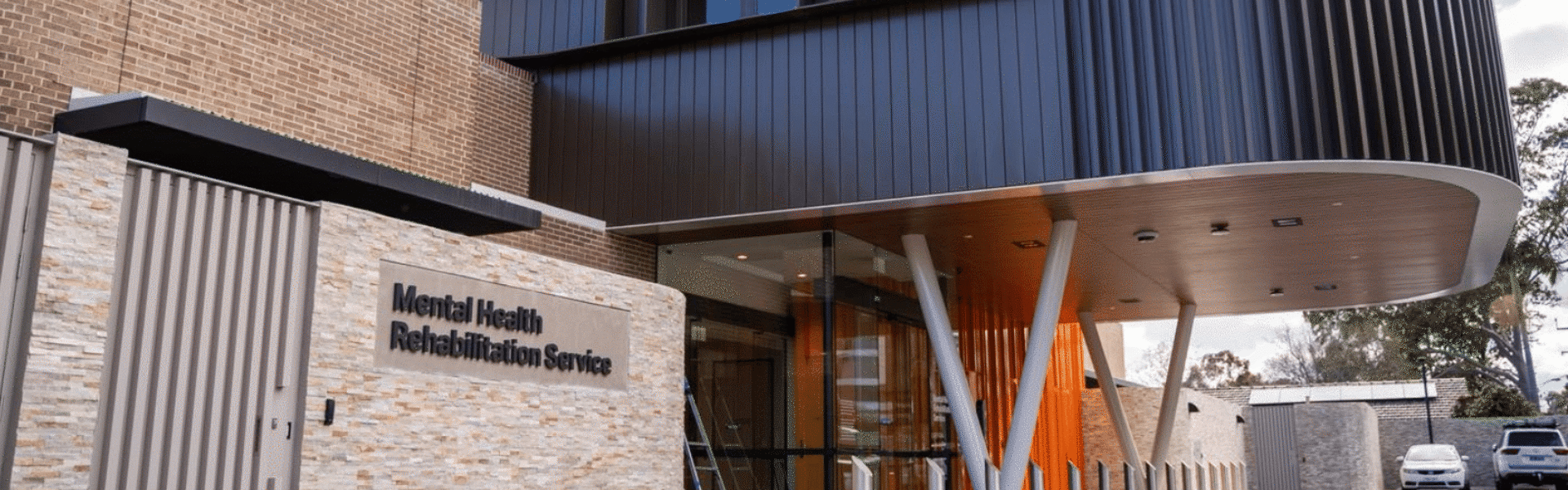
Last month (September 2025) the new Mental Health Rehabilitation Service at TQEH was commissioned.
This new facility provides 24 bedrooms for longer-stay consumers, as well as therapy, creative, active, and social and recreational spaces.
Essential to client comfort, the facility also features internal atriums and outdoor courtyards to provide extensive natural light.
As with Kanganthi across the road, Ikonix Technology was engaged to deliver multiple Ikonix Billboards in strategic places to direct security responses to duress alarms.
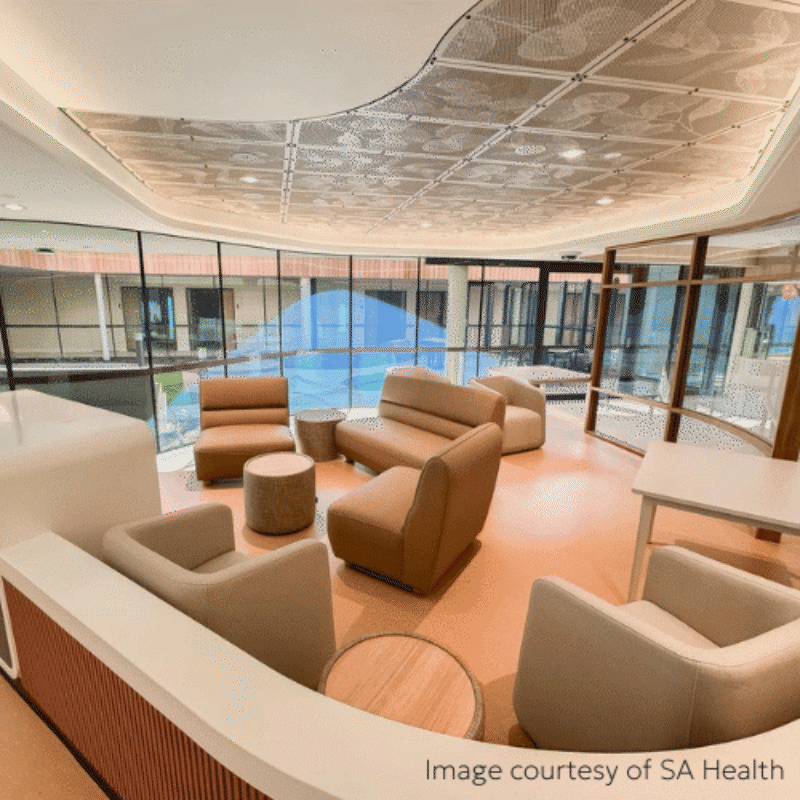
In this deployment, we overcame more unique variables. The open spaces mentioned above create challenges for wireless technologies, and the floor plan is larger and more varied, incorporating the amenities required in a longer-stay environment.
Using the features implemented in prior deployments as a baseload, planning stakeholders for this new facility also investigated adding additional functionality to Billboard.
This included new and unique alarm types and collaborating with new vendors to deliver increasing value, all to keep SA’s frontline workers safe.
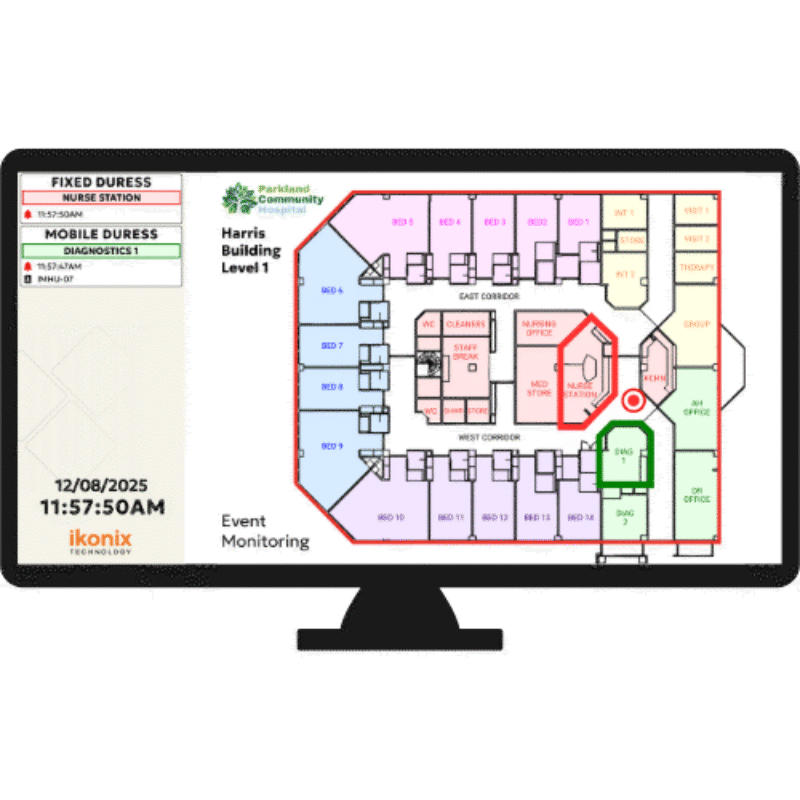
As Ikonix Billboard continues to grow, we have been engaged to deploy units into two new hospitals. Each new site has its own range of legacy or acquired technologies to incorporate, as well as specific, localised workflows Billboard needs to accommodate.
This becomes ever more vital, as recent news in The Advertiser (paywall) explains that Code Black (security calls to threats of or active violence) calls are setting new records across SA Hospitals.

So, what can Ikonix Billboard now offer?
While we started with AiRISTAFlow, because different vendor systems have been deployed at other customer sites, the Ikonix Technology engineering team has been integrating more RTLS brands. These will naturally have different capabilities as determined by the system in place. In every case, even with systems new to us, we have leveraged every RTLS package to create an Ikonix Billboard solution that provides enhanced situational awareness.
By integrating with the fire system, Ikonix Billboard can now display locations and broadcast alerts when those safety systems are triggered.
For another customer, we also included fire safety appliances as icons on the map, which further informs the response to an alarm by showing where the issue was detected and the nearby equipment needed to resolve it.
Not all staff need to wear a mobile duress tag to alert to danger. Targeted to areas where incidents may concentrate, such as triage or other nursing stations, many facilities have fixed duress buttons.
Working with security vendors for these hospitals, Ikonix Billboard can now display them on the map, highlighting the relevant zone when the event is triggered.
Security sensors are increasingly available for a variety of applications. One recent deployment has included Billboard incorporating and publishing the locations of glass-breakage alarms.
Where a monitored window is broken, either by vandalism from outside or as an extension of an internal security incident, Ikonix Billboard can show responders where and when it happened, directing a response to ensure worker, patient, and property safety and security.
In these deployments, the specific nature of the environment requires other location-based sensors.
Recently, in mental healthcare facilities with longer patient stays, this has included anti-ligature alarms on the door top. Given the critical, time-sensitive nature of the response, these are now published on Billboards for clinical intervention, ensuring patient well-being.
The mobile nature of the workforce within any healthcare facility means that the nearest responder may not be near a fixed Billboard location. It may also be that personnel near an incident need to be separately alerted so they can avoid the area until a safety incident is resolved.
Using the LED screens unique to AiRISTA RTLS tags, Ikonix Technology developed methods of broadcasting short incident alerts to the tags. This ensures the highest level of situational awareness for the whole team.
We have also updated Ikonix Billboard to utilise the improvements in the new AiRISTA B4i tag. As discussed in the product announcement, these tags have improved battery longevity and feature newer Bluetooth technology for better tracking and data transfer.
Deploying more Billboards inevitably means they need to cover larger areas. This could be different floors of the same building, or different buildings on the same campus.
Where multiple maps are required, without zooming out beyond legibility or requiring multiple screens to be installed, Ikonix Billboard can cycle through maps. When an incident occurs, the view will fix on that map. If mobile, should the affected personnel move(s) into zones tracked on other maps, this will update to follow. When multiple alerts occur across different maps, Billboard will rotate between them.
With this, Ikonix Billboard continues to grow to meet the needs of new and existing customers over time.